
A Legacy Created: Transforming Hawai'i's Digital Landscape


When Governor Ige took office in December 2014, the state’s information technology systems were decades out of date. Several mainframe systems were written in COBOL, and were intended for hardware that was obsolete and not supported. Employees could not have their pay directly deposited into their bank accounts via electronic funds transfer. This created inefficiencies and delays in public services, and the governor committed to reforms that would increase efficiency, reduce waste, and improve transparency and accountability. He also noted concerns from the community about the value they were getting for their taxpayer dollars, and observed that state departments had "good people working in not-so-good systems," leading to a risk-averse environment. Governor Ige knew that public servants needed modern tools to deliver services in a more efficient and effective manner.
The Governor’s Record of Leadership
Governor Ige made investments in critical information technology systems a priority, even when faced with limited funds. He focused on key strategies used in modernization to ensure success:
This included initiatives like implementing digital document management systems, transitioning to Office 365, providing Adobe Suite, and developing eSign services.
This involved implementing IT governance, establishing an Enterprise Resource Planning (ERP) targeted strategy, upgrading key IT positions and actively recruiting qualified people, finalizing IT system backup, adopting a State Information Technology Strategic Plan, adopting multi-factor authentication (MFA), and implementing cybersecurity awareness training.
This included launching the Aloha+ Challenge Dashboard, installing a fiber network for DLNR remote offices, adding public recreational permitting and information accessibility online, moving the Bureau of Conveyances into the 21st century through digitization, easing voter registration through an online platform, launching Text to 911 capabilities, developing a translator application for executive department websites, adopting Siteimprove and Brandwatch, developing the online Public Land Trust Information System (PLTIS), launching new online portals to report unlicensed activity, implementing online reservations at State Parks, and making public records available online.
This involved implementing a new Learning Management System (LMS).
This was largely driven by the comprehensive overhaul of the state's tax infrastructure (Tax Software Modernization project) and the implementation of new time and attendance and payroll systems (Hawai'i Pay project).
This included establishing an office to strategically plan and develop broadband assets, expanding broadband networks, installing free high-speed broadband internet service to public housing, and deploying new Wi-Fi hotspots.
Examples include the Hawai'i Career Acceleration Navigator (HI-CAN), a free mobile app for hiking trails, and the Safe Travels digital platform.
This is seen in initiatives like the Rapid 'Ōhi'a Death remote aerial monitoring, building narcotics enforcement division prescription drug monitoring information sharing, and launching the DLNRTip app.
This was a critical response to the COVID-19 pandemic.
An efficient and effective government is critical to our community. This administration has made great strides in modernizing state systems and improving transparency and accountability in state government. In eight years, the state’s IT modernization has accelerated, driving down operating costs while providing faster services to customers.
Here are the top five accomplishments of modernization and why they were most impactful:
- Tax Software Modernization (TSM) Project (Hawai'i Tax Online) - Completed 2019
- Impact: This was a comprehensive overhaul of the state's tax infrastructure, replacing nearly every technical system used by the Department of Taxation. It moved millions of records to a single, integrated, secure system. This significantly improved financial operational performance, increasing collections by 4.3% in FY2019 to over $8.3 billion, and saved over 2 million sheets of paper. It streamlined tax collection, reduced processing backlogs from months to hours, improved cash flow for the state, and made e-filing mandatory for many returns, ultimately improving taxpayer services and accountability for non-compliant taxpayers.
- Implementation of New Time and Attendance and Payroll Systems (Hawai'i Pay Project & Time and Leave Project) - Hawai'i Pay full enrollment by end of 2018; Time and Leave Project completed Oct. 2021:
- Impact: These projects brought 65,000 state employees onto modernized payroll and time/leave systems. This was crucial for efficient and accurate accounting of taxpayer dollars used for employee benefits, standardizing practices, and reducing pay processing times and errors. The previous manual systems were prone to significant inefficiencies and errors, so this centralized, electronic system was a fundamental improvement for state operations and fiscal accountability.
- Transition to Digital Document Management & eSign Services (Initial pilots 2015, expanded to executive departments 2018):
- Impact: This initiative significantly reduced paper usage (24,000 pages/month reduction, projected $5M savings and 10M sheets of paper over 2.5 years) and associated costs (ink, printing, labor). Beyond cost savings, it improved communication effectiveness across islands and enabled more efficient delivery of citizen services by facilitating digital workflows and remote access to documents, laying foundational groundwork for a more agile government.
- Development and Implementation of the Safe Travels Digital Platform (2020):
- Impact: This platform was absolutely critical during the COVID-19 pandemic, screening over 8.3 million travelers by November 2021. It was essential for protecting the health and safety of Hawai'i residents and played a key role in safely restarting the state's economy by allowing visitors to return. It demonstrated the state's ability to rapidly deploy large-scale digital solutions in a crisis, significantly reducing physical screening times at airports.
- Finalization of IT Backup (2016):
- Impact: For the first time in state history, a resilient backup for the state's primary data center was established through an MOU with the UH IT Center. This secured critical state IT systems, providing disaster recovery capability and avoiding millions in annual costs associated with building and maintaining a new center. This fundamental infrastructure improvement significantly enhanced the state's IT resilience and ensured business continuity for essential government services.
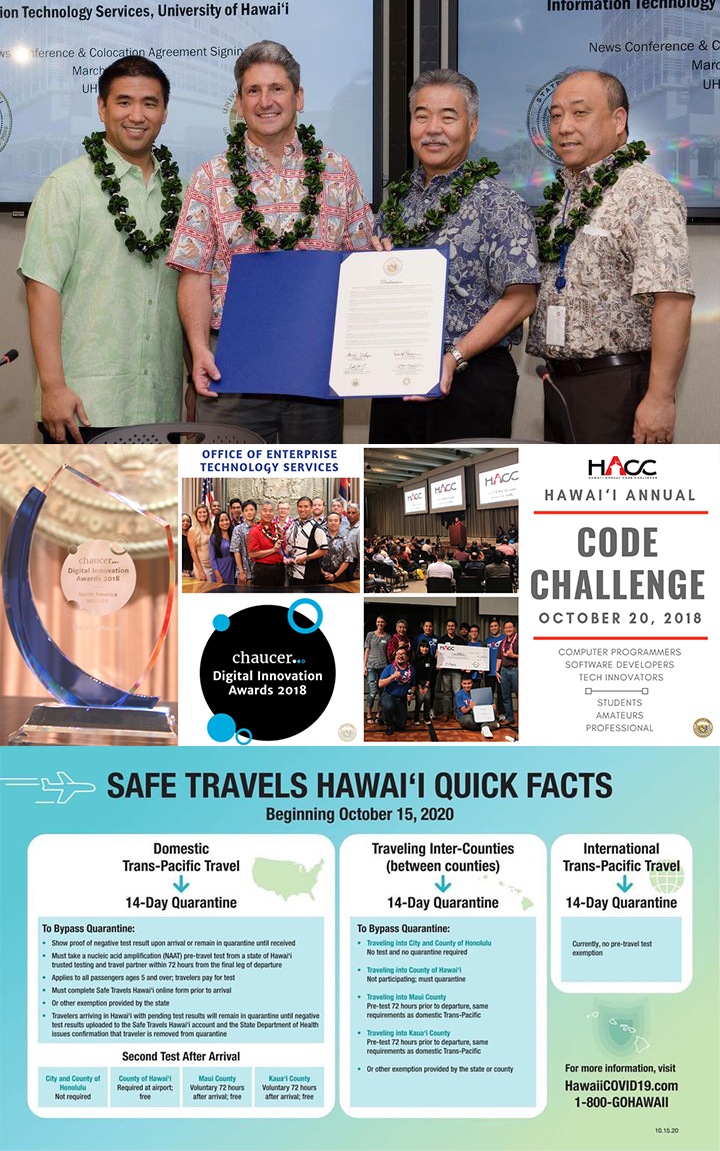
Major accomplishments of modernization of the Ige Administration
2015
- Cloud-first preference set for state departments (ETS/DAGS)
- Digital document management system developed by Employee Claims Division (ECD) (ETS/DAGS)
- Anuenue Interisland Digital Microwave Network achieved "full operating capability" (ETS/DAGS)
- Human Resources Management System (HRMS) upgrade completed (ETS/DHRD)
- State Building Asset Management (SBAM) system completed (DAGS)
- Public Works implemented an online plan retrieval system and digitized bid documents (DAGS)
- Public Works initiated Office 365 pilot for field staff to do project jobsite reports on tablets (DAGS)
- Hawai'i Tax Online (HTO) project initiated (DOTAX - completed in 2019)
- Implementation of IT governance (ETS/DAGS)
- Enterprise Resource Planning (ERP) targeted strategy established (ETS/DAGS)
- State Web Portal Program Manager position filled (ETS/DAGS)
- Aloha+ Challenge Dashboard launched (ETS/DAGS)
- Fiber network installed for DLNR remote offices statewide (DLNR - ongoing until 2022)
- Public recreational permitting and information accessibility added online (DLNR - ongoing until 2022)
- Bureau of Conveyances began multi-phased digitization efforts (DLNR - ongoing until 2022)
2016
- Operational communication platforms activated and migrated to Office 365 (ETS)
- All executive branch employees provided with Adobe Suite (ETS)
- Paper reduction pilot program implemented by HRD/ETS-DHRD's Employees Claims Division (ECD) (ETS)
- Hawai'i Correctional Industries (HCI) partnered with ETS to securely install a document scanning operation (PSD/ETS)
- Rapid 'Ōhi'a Death remote aerial monitoring began using AI tools (DLNR)
- IT backup finalized for the first time in state history through MOU with UH IT Center (ETS/DAGS)
- Online Voter Registration website launched (ETS/DAGS)
- Text to 911 capabilities launched across all four counties (ETS/DAGS)
2018
- Hawai'i Pay project brought 22,000 State employees onto the modernized payroll system (ETS/DAGS - full enrollment by end of 2018)
- Paper reduction pilot program projected to save $500k and 10M sheets of paper in 3 years (ETS)
- Hawai'i Annual Code Challenge (HACC) launched (ETS)
- eSign service expanded to entire executive departments (ETS)
- State Information Technology Strategic Plan adopted (ETS)
- Translator application developed for executive department websites (ETS/DAGS)
- Siteimprove adopted to track accessibility issues and document site analytics (ETS/DAGS)
- Brandwatch adopted for content curation, monitoring, and management (ETS/DAGS)
- Multi-factor authentication (MFA) adopted (ETS)
- Cybersecurity awareness training implemented (ETS)
- Online Public Land Trust Information System (PLTIS) public interface developed (DLNR)
2019
- Tax Modernization project (Hawai'i Tax Online) completed and successfully implemented (DOTAX)
- Mandatory tax e-filing required for certain returns (DOTAX)
- New tax platform saved more than 2 million sheets of paper (DOTAX)
- Improved Financial Operational Performance, with DOTAX collecting over $8.3 billion (DOTAX)
- 400,000 tax abandoned tax accounts revoked (DOTAX)
- Airbnb provided DoTAX with host data to improve tax compliance (DOTAX)
- Public WiFi access increased across the state by DCCA's Cable Television Division (DCCA)
- New Learning Management System (LMS) implemented for professional development of state workforce (DHRD)
- Narcotics Enforcement Division initiated interstate sharing of prescription drug monitoring program (PDMP) information (PSD)
- New online portal launched to report unlicensed activity through MyPVL (DCCA)
- Online reservations implemented at State Parks (DLNR)
2020
- Hawai'i Cultural Resource Information System (HICRIS) online application and tracking system launched (DLNR)
- DLNRTip app for reporting natural and cultural resource violations launched with major updates (DLNR)
2021
- Safe Travels digital platform developed and implemented for incoming travelers (ETS)
- Prioritized the establishment and implementation of an energy ecosystem data governance framework, including "HAVEN" and "Engage" (DBEDT)
- Infrastructure enabled and managed to allow telework during the pandemic (ETS)
- eHawaii.gov Single Sign-On (SSO) service implemented (ETS)
- Time and Leave Project completed (ETS)
- Unemployment Insurance technical support provided during the pandemic (DLIR/ETS/DAGS)
2022
- Hawai'i Career Acceleration Navigator (HICAN) launched (Phase 1) (DLIR/ETS)
- Public IT roadmap and portfolio published online (ETS/DAGS)
- 3.5 million pages of archival records loaded into a free, online repository by Hawai'i State Digital Archives, with bi-lingual interface (DAGS)
- Free mobile app developed to explore hiking trails and access information on native species and plants (DLNR)
- Bureau of Conveyances' core land records system (Land Records Management System) overhauled (DLNR)