
Strength Through Adversity: Responding to the 2018 Kīlauea Eruption
Understanding the Challenge
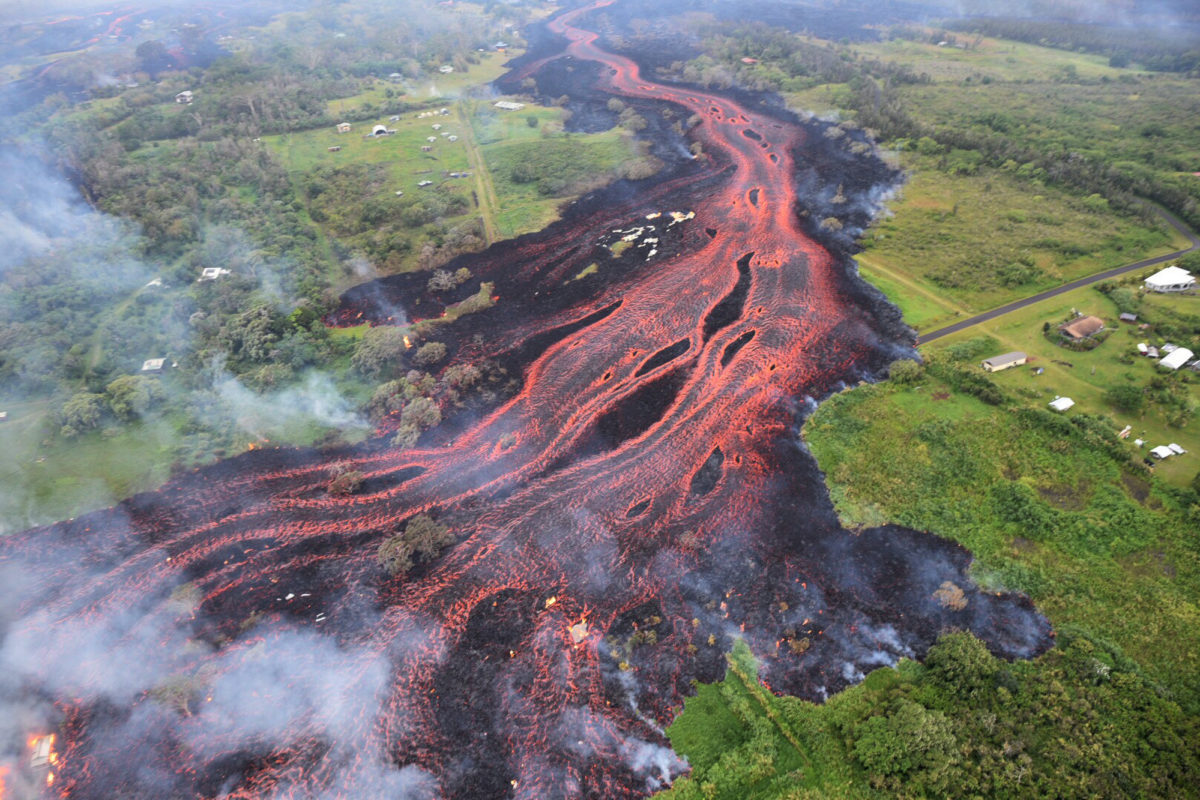
Multiple fissures opened in the Leilani Estates subdivision on Hawai‘i island on May 3, 2018, spewing red-hot lava fountains hundreds of feet in the air and emitting toxic fumes that threatened residents in Lower Puna. The lava flowed onto several streets in the subdivision, which consisted of about 770 structures, and prompted the mandatory evacuation of about 1,700 residents of Leilani Estates. Residents were sheltered at Pāhoa Community Center and Kea‘au Community Center.
Governor David Ige, conferring with Hawai‘i Mayor Harry Kim, signed an emergency proclamation that evening. The danger was of such magnitude that it warrants preemptive and protective action in order to provide for the safety, health and welfare of the residents of Leilani Estates and surrounding areas.
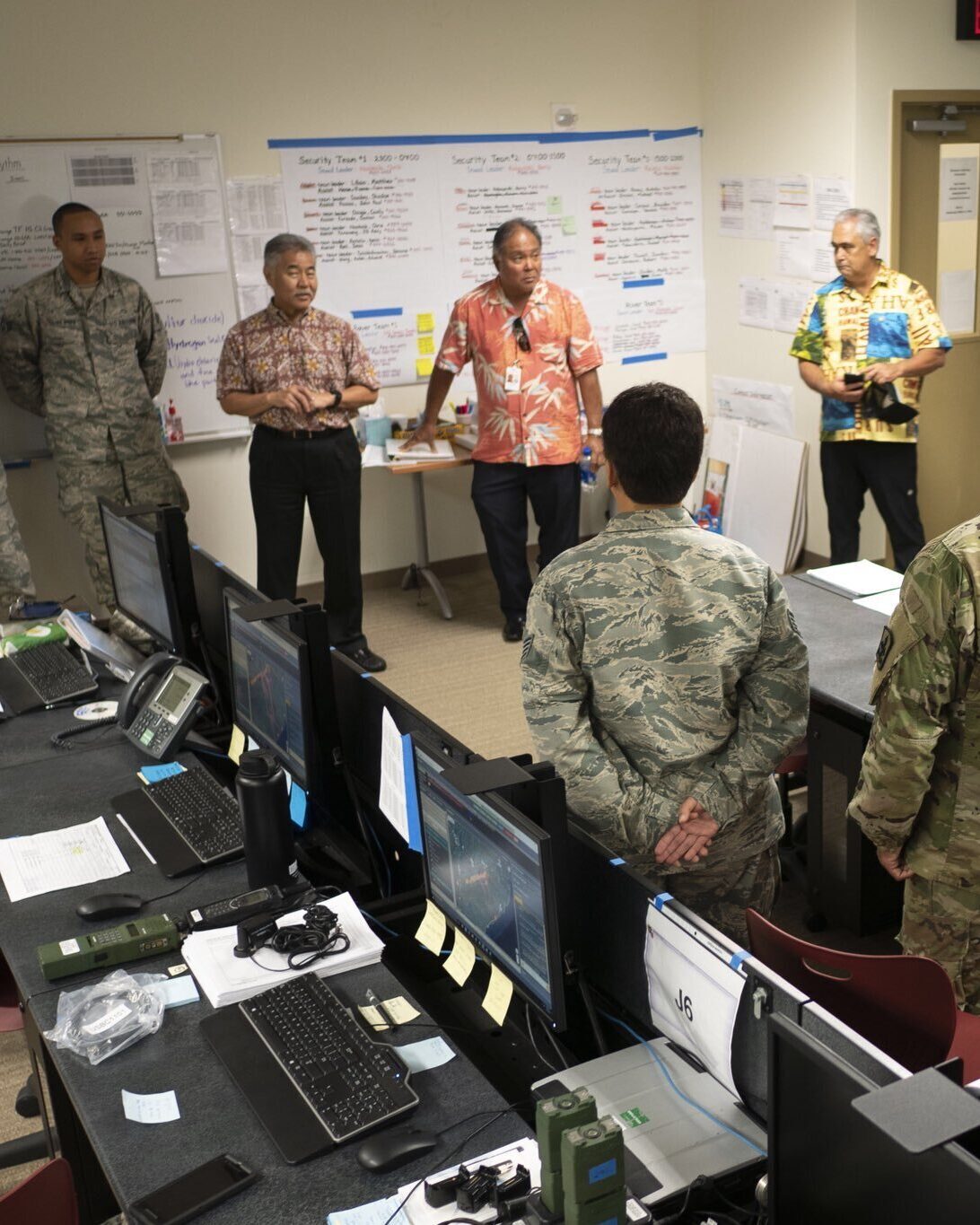
“I am in contact with Mayor Harry Kim and Hawai‘i County, and the state is actively supporting the county’s emergency response efforts. I have also activated the Hawai‘i National Guard to support county emergency response teams with evacuations and security,” - Gov. Ige.
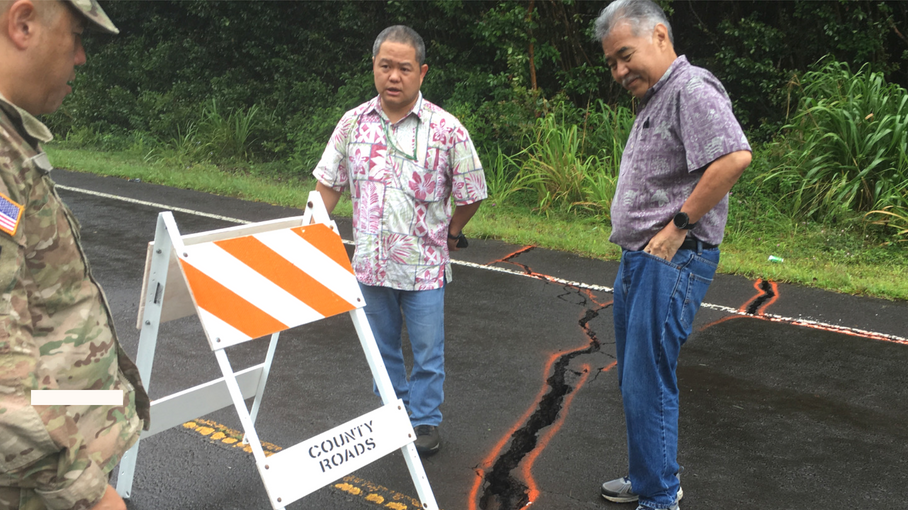
On May 4, Governor Ige went to Leilani Estates on Hawai‘i Island and remarked, “These lava fissures are opening on key arteries and highways. If we lost those, the community would be isolated. We would have to find other ways to evacuate residents. A mass evacuation of the lower Puna District would be beyond current county and state capabilities and would quickly overwhelm our collective resources.”
A Presidential Disaster Declaration for Hawai‘i island was approved on May 9, 2018 just one day after the governor submitted the request. That means federal assistance would be available to repair public roads, parks and schools damaged by the eruption and earthquakes. The governor said he also wanted the state to be ready in case a large-scale evacuation of Puna residents is needed.
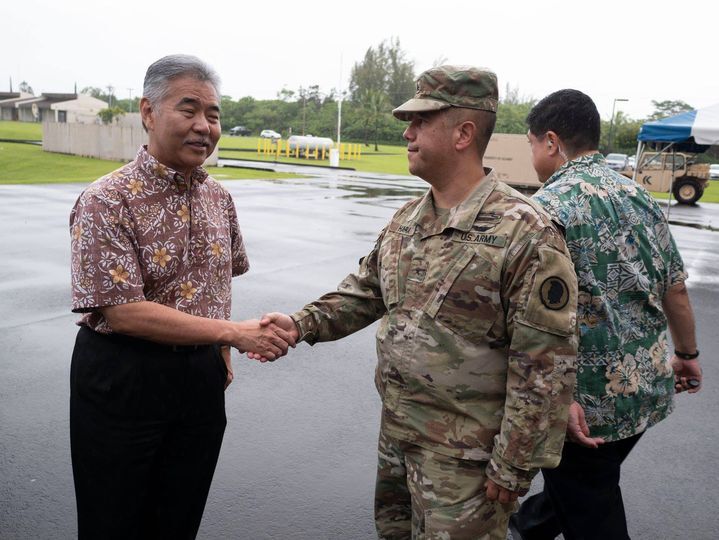
On May 14, the Hawai‘i National Guard (HING) Joint Task Force (JTF) commanded by Brigadier General Ken Hara was established in Hilo.The HING JTF executed many missions in support of the County and the State of Hawaii, including security, traffic control and check points.
On May 15, Governor Ige submitted a request to Secretary of Defense Jim Mattis to designate Brig Gen Hara as the Dual Status Commander (DSC). Secretary Mattis approved the request on May 16, JTF-50 Dual Status Command was established. Service members from the US Army Pacific, Marine Forces Pacific, and Pacific Fleet were attached to JTF-50 in support of the Kilauea Volcanic eruption.
The Puna Geothermal Venture (PGV) facility, which is downslope from the active fissures in Leilani Estates, represented a significant health risk. If the lava flowed over an active geothermal well and caused a blow-out, explosions and release of toxic gases would endanger lives in the community. Governor Ige issued emergency orders to remove flammable pentane from the facility and to quench and plug the wells to prevent a blow-out.
The 2018 Kīlauea eruption in Leilani Estates was the volcano's largest and most destructive eruption in 200 years.
Impact of the eruption
13.7 square miles (8,488 acres) were inundated with lava, destroying 716 dwellings and covering 30 miles of roads. 875 acres of new land were created along the shoreline.
60,000 earthquakes shook the area from May through August. 62 summit collapse events released energy equivalent to a magnitude 5.2-5.4 earthquake.
Halemaʻumaʻu crater grew from 280 feet deep to about 1,600 feet deep.
Over 2,000 people were displaced, with 3,000 residents initially displaced during the eruption.
Total economic costs were estimated at ~$1 billion, including lost jobs, tourism revenue, farm losses, and damage to public infrastructure.
Government strategy and actions
- Governor Ige focused on an all-of-government response, coordinating with state, county, and federal agencies to ensure that the community heard one voice from the government.
- Evacuation orders: Mandatory evacuations were issued for Leilani Estates and other affected areas.
- Mayor Kim signed the Hawai‘i County Emergency Proclamation, allowing immediate access to County resources.
- Governor Ige signed the State Emergency Proclamation, allowing immediate access to State resources.
- National Guard activation: The Hawai‘i National Guard was activated by Governor Ige to assist with evacuations, provide security, and support County first responders.
- Federal disaster declaration: President Trump approved a major disaster declaration, making federal financial assistance available.
- Dual Status Command: Secretary of Defense Mattis approved Dual Status Command to coordinate and integrate US Army Pacific, Marine Forces Pacific, and Pacific Fleet personnel and resources in support of State and County emergency response.
- Emergency housing and aid: Federal emergency housing aid and other relief were provided to eruption victims.
- Monitoring and assessment: Federal, state, and local agencies, including the USGS Hawaiian Volcano Observatory (HVO), US Army Corps of Engineers (USACE), and the Federal Emergency Management Agency (FEMA), teamed up to monitor geographic changes and assess damage. This included using airborne remote sensing to collect lidar and imagery data, providing real-time information for responders and scientists.
- Safety measures: Officials distributed protective masks in Puna and Kaʻū areas due to high sulfur dioxide levels.
- Puna Geothermal Venture (PGV): The Governor issued emergency orders to address the removal of flammable pentane from PGV and the possibility of dealing with deep wells containing hydrogen sulfide. Work was undertaken to pump water into the wells and prepare iron well caps.
Key events and timeline
- May 3, 2018: The eruption begins with the opening of the first fissure in the Leilani Estates subdivision.County of Hawaiʻi Mayor Harry Kim and Governor David Ige declared county and state emergencies. HING activated and JTF established.
- May 4: A 6.9 magnitude earthquake, the strongest on the island in 43 years, strikes beneath Kīlauea's south flank.
- May 10: The lava lake in Halemaʻumaʻu crater at the summit disappears from view as magma drains into the Lower East Rift Zone (LERZ).
- May 14: HING JTF established in Hilo.
- May 15: Governor Ige requested establishing Dual Status Command.
- May 16: Secretary Mattis established Dual Status Command (JTF-50) headed by General Hara.
- May 17: An explosive eruption occurs at the Kīlauea summit, producing an ash plume reaching 30,000 feet above sea level.
- May 19: Lava from the LERZ eruption enters the ocean near MacKenzie State Recreation Area.
- May 25: Fissure 8 reactivates, and a new pit opens on the floor of Halemaʻumaʻu.
- May 29: The caldera downdrop accelerates, with near-daily summit collapse events occurring, each releasing energy equivalent to a magnitude 5+ earthquake.
- June 3: Lava erupted from fissure 8 reaches the ocean at Kapoho Bay.
- June 15: JTF-50 is demobilized and the command reverts to HING only JTF.
- July 1: HING JTF reduced its command and control to Island Command.
- August 4: Activity at fissure 8 significantly decreases, and summit deflation stops.
- August 17: The volcanic alert level is lowered from Warning to Watch as the eruption enters a pause.
- August 21: Lava ocean entries become inactive.
- September 5: No active lava is observed after this date. HING mission ends.
- October 5: The volcano alert level is lowered to Advisory.
- March 26, 2019: The Volcano Alert Level is lowered to Normal, indicating a non-eruptive, background state.