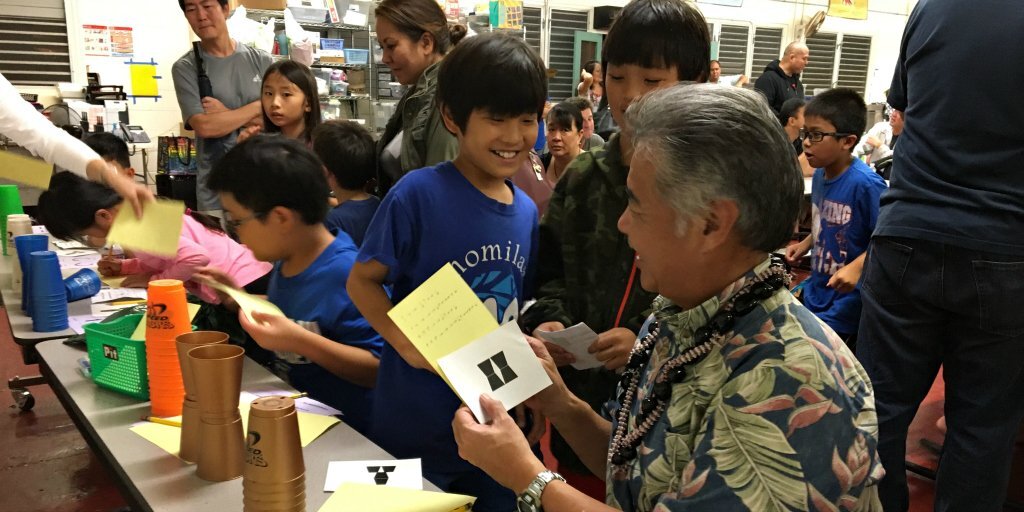
Public Education is the Great Enabler of Dreams
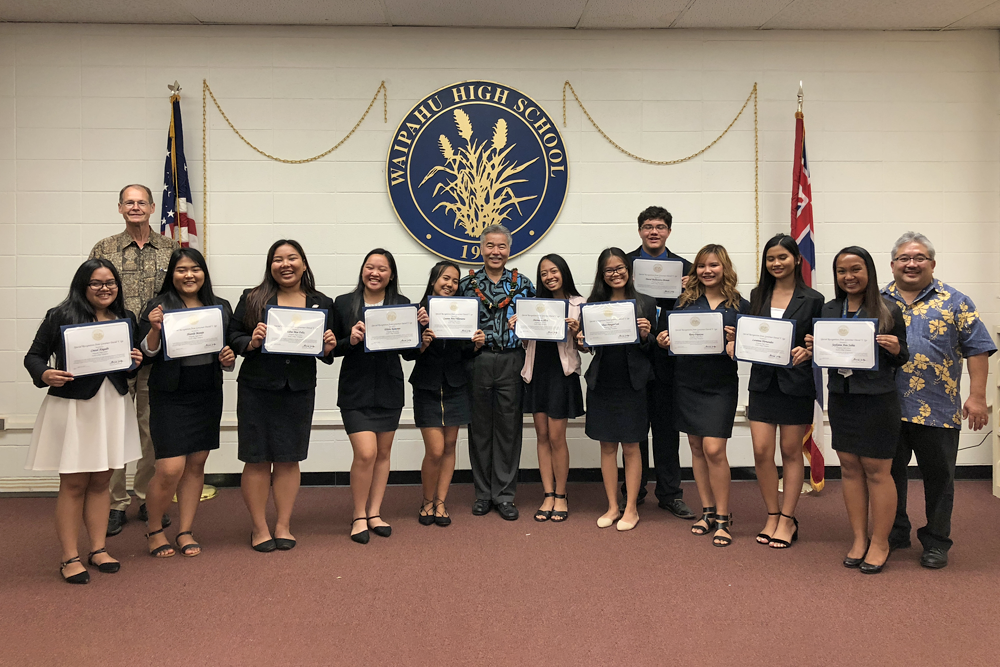
Understanding the Challenge
“Public education is the great enabler of dreams.” — Governor David Ige
This vision of what Hawai‘i’s public schools and the University of Hawai‘i system could be has been at the heart of Governor Ige’s mission to improve education. Back in 1987 as a first-term legislator, the governor worked with newly elected Gov. John Waihee, and Schools Superintendent Charles Toguchi to establish the first of two public Hawaiian immersion programs at Waiau Elementary. “People were saying to save the culture, we had to save the language,” said the governor. “From the brink of extinction with only 100 native speakers, now the language is spoken by thousands of people.” In 1993, then-Rep. David Ige worked with Sen. Mike McCartney to develop an omnibus education bill that became a landmark piece of legislation. It gave public schools more control over their own resources through the Student Weighted Formula to improve and innovate.
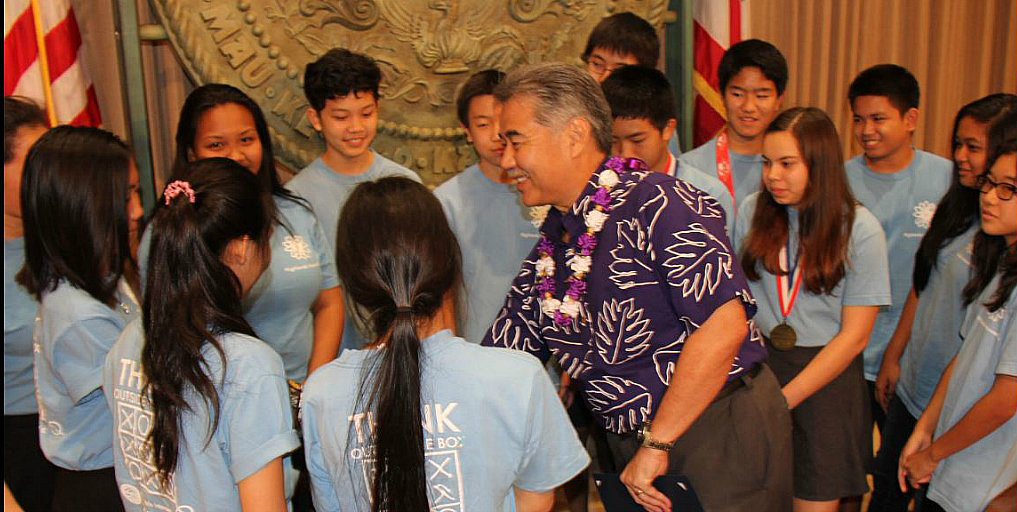
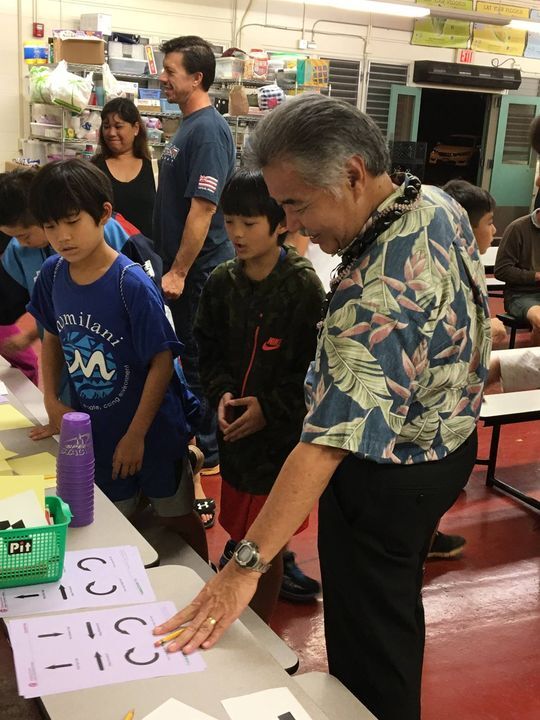
Public education is one of the most important services provided by the State of Hawa‘i. Here are strategic initiatives in public education:
- Historic Investment in Classrooms: $100 million from the 2016 legislature for air conditioning and heat abatement so students could learn better. The DOE succeeded in cooling 1,300 classrooms at 88 schools on five islands, with more improvements to come.
- Expanded Early College Programs: Students at over 43 public high schools can earn college credentials tuition-free, with some even graduating with associate degrees before high school. The governor advocated for bringing Early College to every public high school
- Implemented the Hawai‘i Promise scholarship program, a need-based scholarship program designed to make college affordable to all qualified Hawai‘i students.
- Hawai‘i’s Blueprint for Public Schools was developed by the governor’s team in 2016, based on wide community input, to encourage school empowerment and innovation. It helped guide the DOE’s strategic plan, moving away from a top-down, one-size-fits-all focus.
- The first-ever Hawai‘i Early Childhood State Plan in 2019 provided a collaborative roadmap to guide public and private efforts. The governor has called for a universal, statewide, public preschool system for every child in Hawai‘i.
- Governor’s Emergency Education Relief (GEER) innovation grants awarded to 31 schools, colleges and organizations across the state. The federal funds are being used to build on the Ige administration’s Blueprint for Public Education to set a course for educational change and reform following the pandemic. Other funds were directed to the Hawai‘i Online Portal for Education (a distance learning teacher academy) and “Next Steps to Your Future,” a free UH transition-to-college program.
- Focus on 21st-Century Skills and Learning: The administration aimed to empower public schools and the university, focusing on skills relevant for the modern workforce.
- Strategic Investment in Broadband Services: In 2021, Governor Ige designated the University of Hawaiʻi System to lead and coordinate efforts to ensure all Hawaii's citizens have access to robust and reliable broadband services.
- Major DOE and UH capital improvement projects under the Ige administration have included new or renovated performing arts and media centers, athletic and STEM facilities, improved classroom buildings and new schools for growing communities. In 2017, Governor Ige got personally involved in labor negotiations to win four-year contracts for teachers and school personnel. Afterward, he said he wanted to bring “labor peace” to the process so they could focus on improving our schools.
Governor Ige’s record in leadership for higher education in Hawaii
Classes started at Hawaiʻi Community College's new branch campus at Pālamanui in 2015, providing classroom space, teaching kitchens, and science labs, and offering distance learning opportunities. UH West Oʻahu expanded its campuses and offered a wider curriculum, including new degree programs in Creative Media and Natural Sciences.
Campuses across the UH system received over $30 million in federal grants to create and improve programs for Native Hawaiian student success. A partnership with Kamehameha schools was formalized to help more K-12 students access and succeed in higher education. In 2021, over $17.7 million in federal funding was awarded to 34 UH Native Hawaiian education programs.
- XLR8UH, the UH's Proof of Concept Center and Venture Accelerator, was established to invest in innovative ideas and commercialize university intellectual property.
- UH attracted $505 million in extramural funding in FY 2022, marking the first time $500 million is exceeded. From 2015-2022, UH received more than $3.4 billion in extramural funds and grants.
- The Hawaiʻi Innovation Initiative moved forward with legislative measures (Act 38 and Act 39 in 2017) to lift restrictive statutes, allowing UH to participate financially in startups, provide strategic marketing, and offer instruction and mentoring to entrepreneurs.
- New innovation labs (i-Lab at UH Mānoa in 2016 and SPACE at Shidler College of Business) were opened to foster innovation and entrepreneurship among students.
- UH West Oʻahu was designated a National Center of Academic Excellence in Cyber Defense Education, building on prior designations for Honolulu Community College and UH Mānoa.
- UH spearheaded CyberHawaiʻi, a partnership to implement a "cyber-ecosystem" to defend Hawaiʻi against cyberattacks.
- UH continues to host annual GenCyber Hawaiʻi camps and Poʻoihe Cyber Security Exercises, created the UH Mānoa cyber range, and developed cybersecurity/information security assurance curriculums across the UH System.
Full WASC accreditation was reaffirmed for all three four-year campuses in 2015.
Significant contribution to the goal of having 55% of working-age adults (25-64) earn a two- or four-year degree by 2025.
Significant progress in increasing enrollments and the number of STEM graduates, with notable increases across UH Mānoa, UH Hilo, and UH Community Colleges between 2010-11 and 2016-17.
Created sector partnerships with businesses, government agencies, and other groups in eight sectors to improve the linkage between education and workforce needs.
UH facilitated the implementation of early college and other dual credit opportunities in over 30 high schools. The annual College and Career Readiness Indicators Reports (CCRI) were produced, recognized nationally for providing useful information on college readiness. Hawaiʻi P-20's Data eXchange Partnership (DXP) was established as a statewide cross-agency, longitudinal data system.
Creation of the UH Office of Sustainability to support and coordinate sustainability work across campuses, and the Office of Energy Management to achieve the UH Net Zero Energy mandate by 2035.
Creation of the UH Office of Institutional Equity (OIE) to improve institutional responses to allegations of sex discrimination and gender violence across all ten campuses.
Swift transition to online learning for all 10 campuses in March 2020, with continued online operations for the fall semester. Researchers contributed to vaccine search, advised government agencies, and provided free COVID-19 testing.
The program graduated more than quadruple the number of students who earned their certification in previous years.
Completion of a new 70,000-square-foot Life Sciences building at UH Mānoa with state-of-the-art teaching and research laboratories.
UH Mānoa consistently ranked among top U.S. public schools and national universities, with strong performance in social mobility.
UH Mānoa ranked in the top 1% of worldwide universities by the 2021 Times Higher Education World University Rankings.
Embarking on a vision to expand pre-K for our keiki statewide
Public pre-K in Hawai‘i is vital for fostering children's success and promoting equity. High-quality early learning experiences significantly boost kindergarten readiness and have been shown to lead to long-term benefits, including higher graduation rates and earnings. Providing accessible public pre-K addresses educational disparities and offers a strong foundation for all children, contributing to a more equitable and prosperous future for the state.
In 2020, Governor Ige signed Act 46, which established the goal to provide universal access to preschool for all three- and four-year-olds. In 2022, Governor Ige signed Act 257, the historic legislation that accelerates Hawai‘i’s vision for expanded early childhood education. The act appropriates $200 million, the largest investment in early education in Hawai‘i’s history, to construct and renovate pre-kindergarten facilities in Hawai‘i by 2024.