
Investing in Our Foundation, Balancing Growth, Inspiring Innovation
In December 2014, the State of Hawaiʻi's financial condition was precarious: a shrinking general fund (spending $200M/year over revenue, projected to dwindle to $35M cash balance against $6B in expenditures), under $100M in the rainy day fund, and tens of billions in unfunded retirement and health liabilities. The State was essentially living "paycheck-to-paycheck."
Governor Ige knew that any economic recovery had to start with investments in our visitor industry to help them recover and grow. The low interest rates and borrowing cost also provided an opportunity for long overdue investments in the State’s critical infrastructure to directly boost jobs and economic activity.
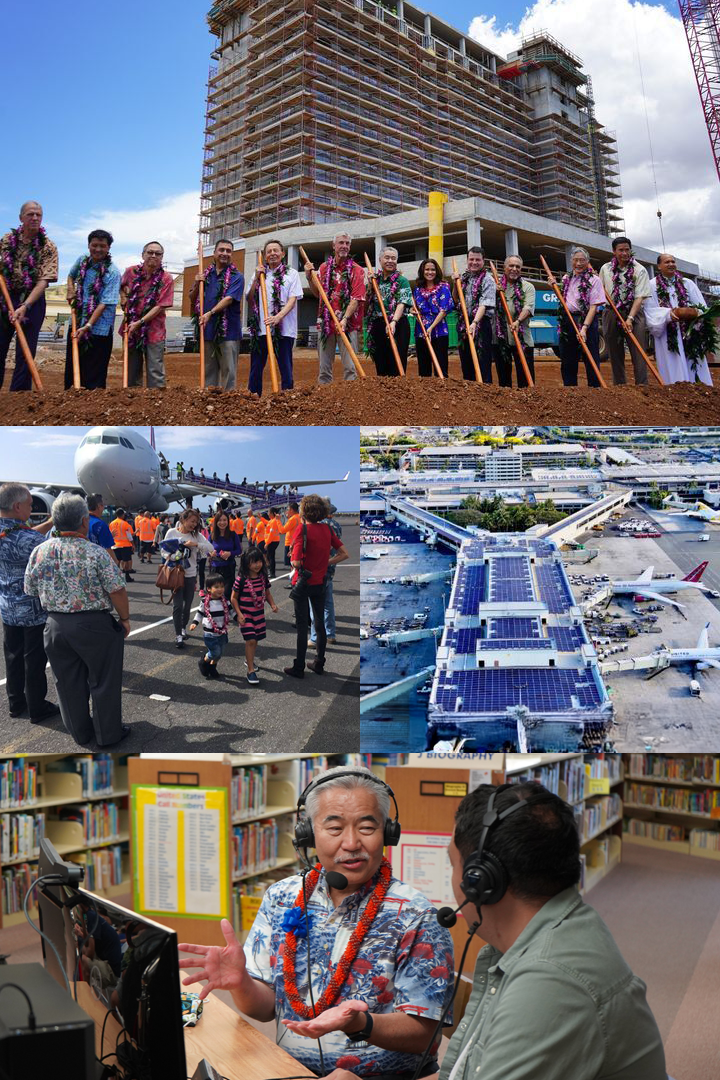
Initially, to help the visitor industry recover and grow, the key initiatives focused on:
- Expanding the U.S. Customs pre-clearance program: This aimed to streamline the entry process for international visitors.
- Attracting more air carriers: The administration worked to increase the number of airlines serving Hawai'i.
- Virgin America: Opened operations in November 2015.
- Jin Air: Started service from Incheon to Hawaiʻi in December 2015.
- AirAsia X: Started service from Kuala Lumpur to Hawaiʻi in June 2017.
- Cebu Pacific: Had plans for service to Manila by early 2016.
- Japan Airlines restarted daily, non-stop service between Narita International Airport (Tokyo) and Kona International Airport on September 15, 2017, after a seven-year hiatus. This marked the return of international direct flights to Kona.
- Southwest Airlines began service to Hawaiʻi in March 2019.
- All Nippon Airways (ANA): Began A380 service between Japan and Honolulu in May 2019.
- Modernizing aging airports: This involved upgrading airport infrastructure to enhance the traveler experience and improve efficiency and safety. Specific projects included new Consolidated Car Rental Facilities and the Mauka Concourse at Honolulu International Airport, the new Consolidated Car Rental Facilities at Kahului Airport, and the Federal Inspection Facility (FIS) in Kona, all while adhering to “green “ building standards.
These efforts led to record-breaking visitor arrivals and spending in 2019, with the industry yielding $17.75 billion in revenue and attracting approximately 10.4 million visitors, supporting 216,000 jobs statewide.
However, the very success of tourism in 2019 brought its own set of challenges, including increased traffic, pressure on natural resources, and congested public spaces. These issues prompted a re-evaluation of the state's heavy reliance on tourism.
The COVID-19 pandemic further emphasized the critical need for a more balanced local economy. This led to a strategic pivot towards fostering emerging industries, expanding broadband infrastructure, and attracting "mindful, high-value travelers." Priorities included:
Focus on destination management through Destination Management Action Plans (DMAPs) for each island, natural resource protection, reservation systems for State parks (Hā'ena, Diamond Head, Wai'ānapanapa), and cultural preservation.
Provided free high-speed internet to seven Hawaiʻi Public Housing Authority (HPHA) properties, upgraded wireless infrastructure, established new multi-gigabit broadband facilities (connecting to 430 studios across 3 continents), expanded IT apprenticeships, and prioritized broadband deployment.
Funded startups (SBIR: $5M to HTDC), attracted businesses (51 new to HOST Park), completed incubator and energy CIP projects, distributed microloans, supported creative industries (Kaka'ako Entrepreneurs’ Sandbox: $3M federal, $3M state, $1.4M private; opened Oct. 2019), established a Global Aquaculture Accelerator (Hatch Inc.), launched the Technology Readiness User Evaluation (TRUE) Initiative (March 2020), offered innovation grants ($10M for PPE), and launched the Digital Currency Innovation Lab.
Developed IT apprenticeship programs ($2.99M USDOL grant), expanded robotics/STEM in schools, supported diverse micro-projects (welding, housekeeping, etc.), diversified apprenticeships (IT, healthcare, culinary), assisted employers (RUDDER: 43 employers, 1,000+ hires), promoted HireNet Hawai'i, and equipped displaced workers with tech skills.
Capitalized the Green Energy Market Securitization (GEMS) program (>$90M financing; leveraging $67.5M GEMS with $37.3M private for nearly $105M clean energy investment), established a solar desalination project ($2M DOE SunShot), signed clean energy agreement with Navy (2016), and celebrated Hydrogen and Fuel Cell Day.
Leveraged Hawaiʻi's brand at Tokyo International Gift Show (TIGS) (e.g., $15.2M direct sales in 2016), attracted foreign students (China, Okinawa), fostered clean energy cooperation with Okinawa (MOC extended in May 2022) and Korea (Korea Institute of Energy Technology Evaluation and Planning (KETEP), positioned Hawaiʻi as "tech bridge" (Blue Startups' East Meets West), promoted U.S. Business Day in Taiwan, rebranded overseas offices, and introduced business opportunities to Guangdong.
Constructed and updated economic dashboard (April 2020), produced economic projections, and conducted virtual Small Business Regulatory Review Board meetings.